A watch box can be beautifully finished, foil-stamped, and lined in the right color, and still feel wrong the moment the watch goes in. If the piece rattles in an oversized cavity, or the lid presses down on a domed crystal, or a chunky bracelet bulges against a slot that is too narrow, the buyer registers it instantly. Fit is the detail that separates packaging that flatters the product from packaging that fights it, and getting it right is a matter of measuring the watch properly and speccing the interior around those numbers rather than around a guess.
Measure the watch, not the wrist
The single most common mistake is designing a box around case diameter alone, because diameter is the number everyone quotes. It matters, but for packaging it is the least important of the three measurements you need. Take the case diameter across the face excluding the crown, the case thickness from caseback to the top of the crystal, and, most importantly, the lug-to-lug distance, which is the length of the watch from the tip of the top lugs to the tip of the bottom lugs.
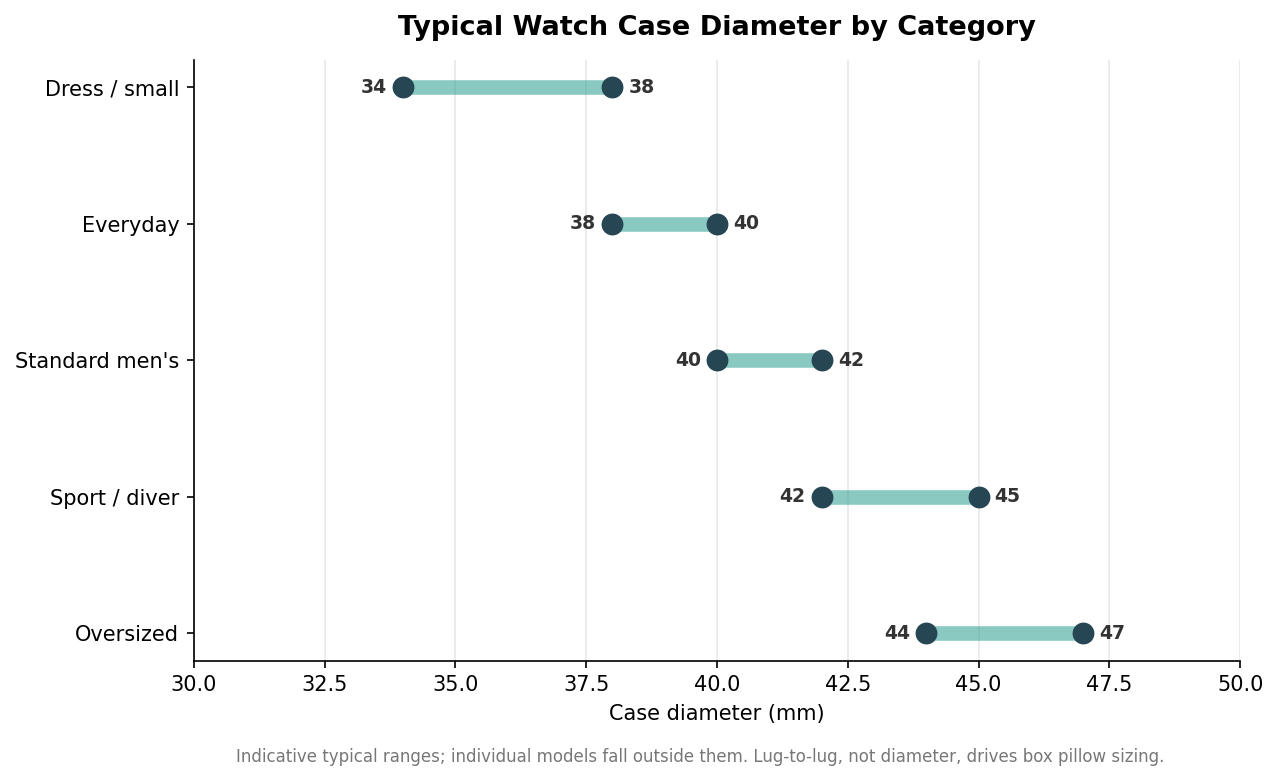
Diameter ranges are helpful for knowing roughly what family a watch belongs to. Dress pieces tend to sit around 34 to 38mm, everyday watches around 38 to 40mm, standard sport and men’s models around 40 to 42mm, and divers and larger sport watches from 42mm up past 45mm. But two watches with the same 40mm dial can have very different footprints because their lugs stretch differently. Lug-to-lug is what actually determines how the watch sits on a pillow, and it is frequently much larger than the diameter suggests: a vintage 36mm piece might run about 43mm lug-to-lug, while a modern 42mm diver can reach roughly 51mm. Spec the interior to the lug-to-lug and thickness, and let diameter be a sanity check.
Size the pillow to the lug-to-lug
The pillow or cushion is the part that carries the watch, and its job is to hold the strap or bracelet in a gentle curve without stretching it or letting the watch flop. Pillows are generally offered in a few sizes keyed to lug-to-lug rather than to diameter. A small-to-medium pillow suits vintage and dress watches in the 36 to 40mm lug-to-lug range, a medium pillow fits most contemporary watches around 42 to 45mm lug-to-lug, and a medium-to-large pillow is needed for big divers in the 50 to 52mm range. If you are producing boxes for a single model, size the pillow to that watch specifically; if the box has to accommodate a whole brand line, size it to the largest piece you expect it to hold and accept that smaller watches will sit slightly looser.
A pillow that is too small is worse than one that is slightly too large. An undersized pillow forces the bracelet into a tight bend that stresses the links and the clasp, and it makes the watch look crammed. A marginally oversized pillow simply leaves a little air, which is far more forgiving. When in doubt, round up.
Match the slot width to the strap
If your box uses slots rather than a single pillow, the width of each slot has to be set by the strap or bracelet, not by the case. This is where thickness sneaks up on people. A thin leather or rubber strap needs very little room, but a steel bracelet is wider and taller, and a heavy dive bracelet can stand 8 to 10mm tall when laid flat, which changes what a slot has to accommodate.
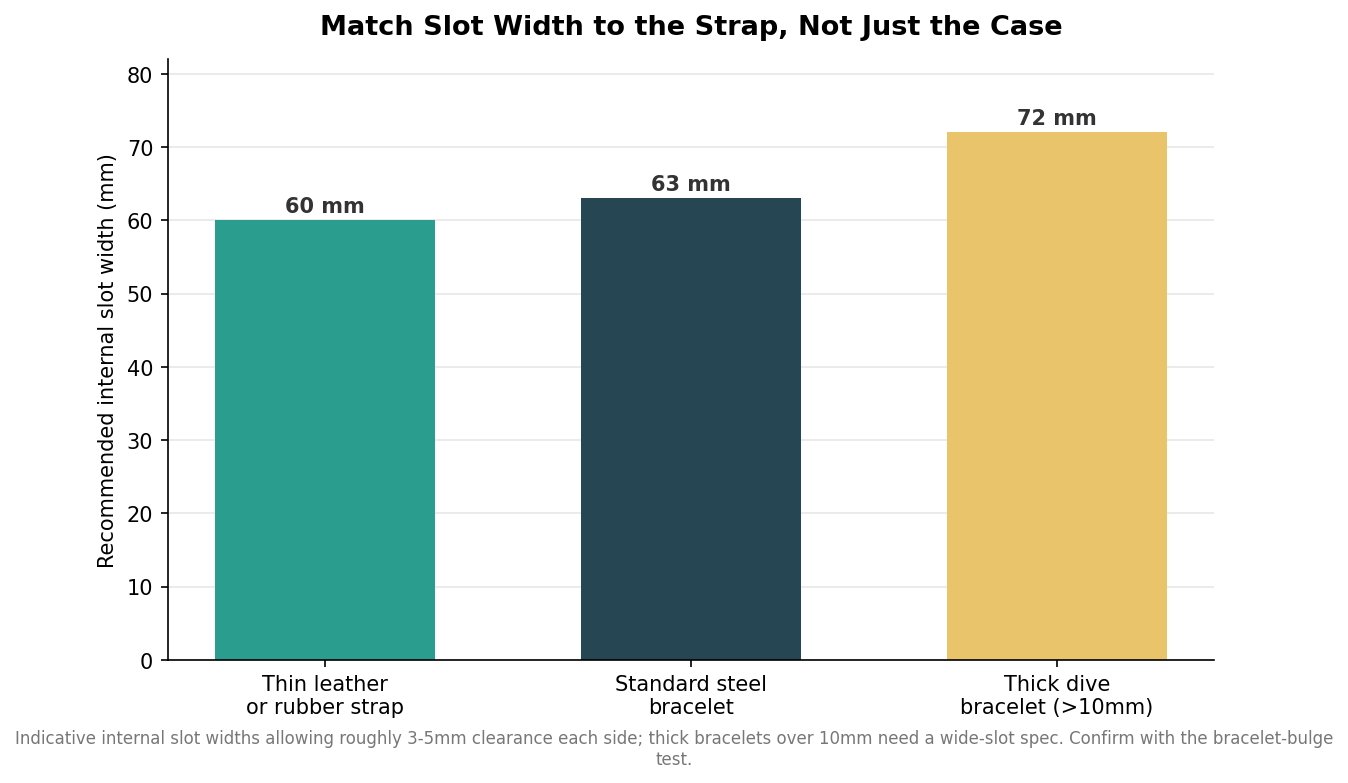
As a working guide, a thin strap is comfortable in a standard internal slot of around 60mm, a typical steel bracelet wants something closer to 62 to 65mm, and a thick dive bracelet over 10mm tall needs a wide-slot specification in the 70 to 75mm range. The principle underneath the numbers is to leave roughly 3 to 5mm of clearance on each side of the bracelet so it settles in without pinching. Slot spacing matters too when a box holds several watches: centers spaced about 50mm apart crowd larger pieces, while 60mm or more, and ideally 70mm for 46mm-plus watches, keeps neighbors from touching.
Leave headroom under the lid
Interior height is the measurement most often forgotten, and it is the one that produces the worst outcome when it is wrong, because a lid that closes onto the crystal can scratch or even crack it. Take the case thickness and add clearance above it. Most watches sit comfortably with at least 3 to 4mm of space between the top of the watch and the underside of the lid, and dive watches with thick crystals, often 14 to 16mm tall themselves, need that clearance respected rather than trimmed to save box height. Remember that the watch sits on top of a pillow, so the real internal height you need is the pillow’s seated height plus the case thickness plus that top clearance. Build the box to close gently, never to compress.
Confirm before you commit
Because a bulk order locks in one interior for thousands of units, the last step is to prove the fit on a physical sample before you approve production. Put the actual watches, or the largest and smallest you expect, into a pre-production sample and check three things. The lid should close without any contact with the crystal. The watch should not shift when the box is tilted. And the bracelet should lie flat in its slot without the center links bowing upward, the so-called bracelet-bulge test; if the links rise, the slot is too narrow and the bracelet is under strain. Confirming fit on a real unit costs a few days at the sampling stage and saves you from discovering a problem across an entire run. Measure the watch honestly, size the pillow and slots to the lug-to-lug and the strap, leave genuine headroom under the lid, and the box will do what good packaging is supposed to do, which is disappear and let the watch look its best.