A watch can survive years of daily wear and still arrive at a customer scratched, loose, or rattling because the parcel around it was an afterthought. The branded box you invested in was designed to present and protect the watch at rest, not to absorb a fall off a conveyor. Shipping a watch well is a separate design problem, and it is worth specifying deliberately before your first large run.
Treat the presentation box and the shipping box as two different jobs
The rigid, pillow, or drawer-style box a customer opens is packaging in the retail sense: it holds the watch on a cushion, carries your branding, and creates the unboxing moment. It is not built to take repeated drops. The outer corrugated shipper has the opposite job. It never gets seen on the shelf, but it is the layer that meets the loading dock, the sorting belt, and the doorstep. Double-boxing is the standard approach: the presentation box goes inside a corrugated shipper with cushioning all around it, so transit forces are absorbed by the outer carton rather than by the box the customer keeps. For higher-value pieces there is a second reason to keep the outer plain and unbranded, which is discretion. A shipper that advertises a watch brand on the outside is an invitation to theft in transit, so many brands ship in a neutral outer with no logos and declare value only on the carrier paperwork.
Build a cushioning layer that immobilizes the box
The goal of cushioning is not just softness, it is stopping movement. A presentation box that can slide or rattle inside the shipper will batter its own corners and the watch inside it. Aim to suspend the inner box so it cannot touch the walls of the outer carton, with a consistent buffer on every face. A common working guideline for small, fragile parcels is roughly two inches, about five centimeters, of cushioning on all sides, though the right amount depends on the weight of the item and the fragility of the finish. The cushioning material itself is a choice with trade-offs. Molded pulp trays are recyclable and hold a shape well for a known box size. Polyethylene plank foam is clean, reusable, and good for a repeatable product. Foam-in-place conforms to any shape but adds cost and a machine. Loose void fill such as air pillows or paper is cheap and flexible for mixed orders, but it settles, so it needs enough volume to stay tight. Whatever you choose, the test is simple: after packing, shake the parcel. If you can hear or feel the inner box move, it is not immobilized yet.
Match the corrugated grade to the weight and value
Corrugated board is rated for stacking and puncture resistance, and the two common measures you will see quoted are edge crush test, or ECT, and burst strength. For a single-watch parcel, a single-wall 32 ECT board, historically equivalent to roughly a 200-pound burst rating, is a typical starting point and is usually plenty for a light, well-cushioned box. If you are shipping heavier multi-watch sets, using a rigid metal presentation case, or you simply want more crush margin in a long carrier network, stepping up to double-wall board or a 44 ECT grade buys headroom. Size the shipper around the cushioning, not around the presentation box. A carton that is barely larger than the inner box leaves no room to suspend it, while one that is far too large wastes material and lets contents shift. The right internal dimension is the presentation box plus your intended buffer on each face.
Prove the system with an ISTA 3A run before you commit
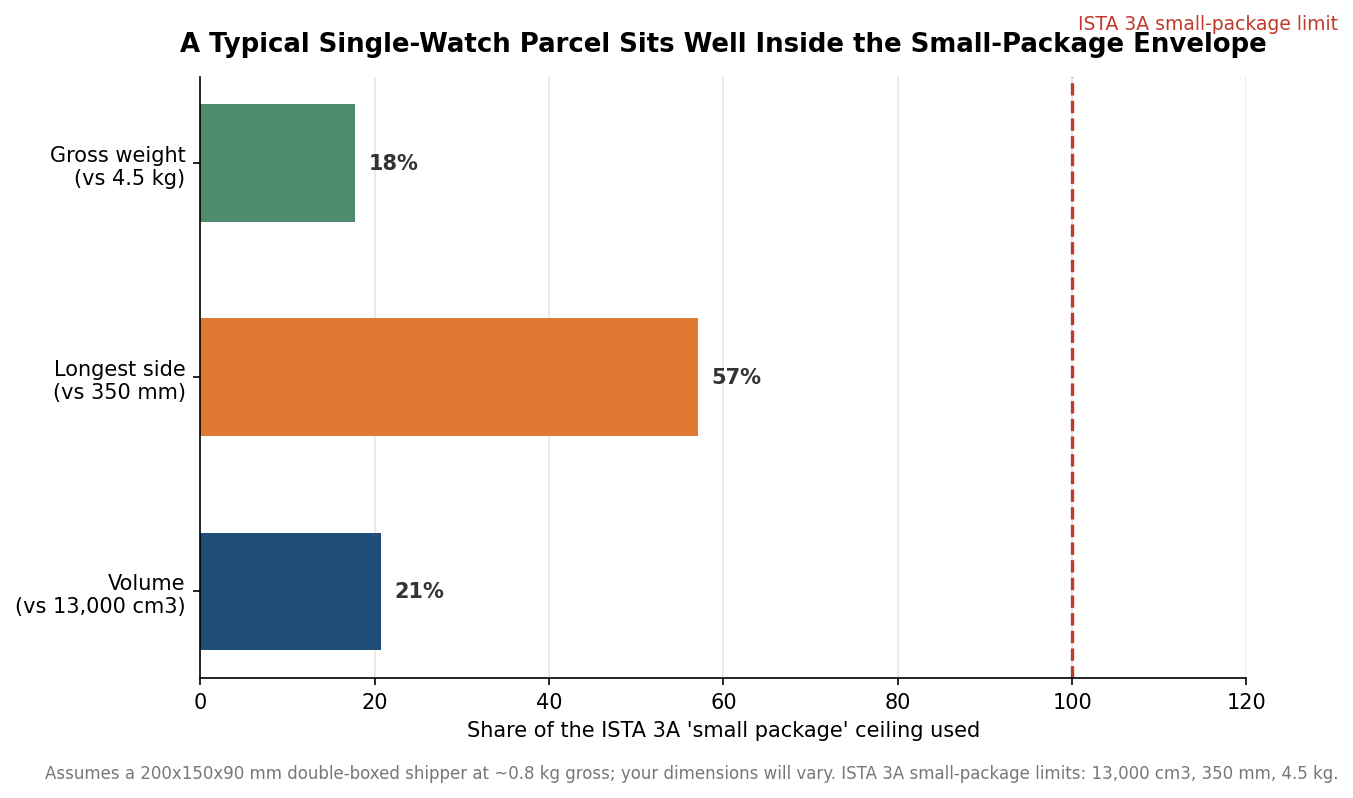
The most reliable way to know your packaging works is to test the actual assembled system, watch plus presentation box plus cushioning plus shipper, rather than trusting any single component. ISTA Procedure 3A is the widely used general-simulation test for individually shipped parcels moving through a small-parcel carrier network. It puts the packaged product through atmospheric conditioning, random vibration that mimics a truck bed, and a sequence of drops onto faces, edges, and corners, so it reproduces the kinds of abuse a real parcel meets. A single-watch shipment falls into the standard’s small-package category, defined as a volume under 13,000 cubic centimeters, roughly 800 cubic inches, a longest dimension of 350 millimeters, about 14 inches, or less, and a gross weight of 4.5 kilograms, about 10 pounds, or less. Most single-watch parcels sit comfortably inside those ceilings, which is useful because the small-package sequence is shorter and cheaper to run than the full standard. Testing a representative sample before a production run is far less expensive than discovering a weak corner after a thousand units have shipped.
Budget the stack and the lead time honestly
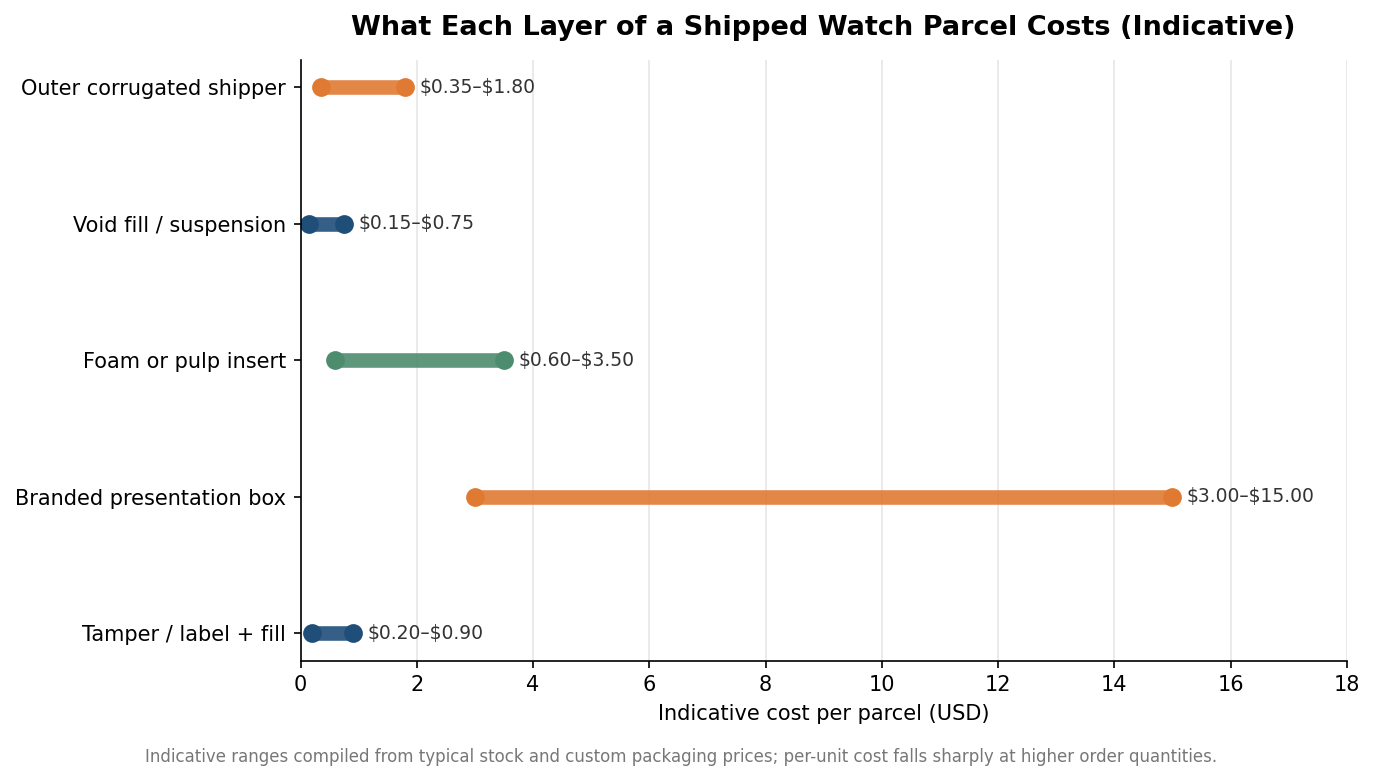
Packaging cost is a stack, not a single line. The branded presentation box is usually the largest single component and varies widely with material and finish, from a few dollars for a printed paperboard box to well into double digits for rigid, foil-stamped, or wood constructions. The protective layers, the foam or pulp insert, the corrugated shipper, and the void fill, typically add somewhere in the region of one to five dollars per parcel at modest volumes, and all of these fall sharply per unit as order quantities rise. Treat the specific figures here as indicative rather than quotes, because grade, print, finish, and quantity move them a great deal. Lead time is the other planning variable: stock corrugated shippers and generic foam are usually available quickly, while custom-printed presentation boxes and tooled inserts commonly run several weeks from proof approval and carry minimum order quantities. If a launch date matters, order the custom components first and treat the protective outer packaging as the fast, flexible layer. Finally, close the loop with the carrier: declare the real value, add signature on delivery for anything worth stealing, and keep the outer carton quiet.
Packaging a watch for shipping comes down to separating presentation from protection, immobilizing the inner box inside a right-sized shipper, matching the board to the load, and proving the whole system with a transit test before you scale. Get those four right and the parcel becomes the boring, reliable part of the customer experience, which is exactly what it should be.