“Eco-friendly” is the easiest claim to print on a watch box and the hardest to actually deliver, because a rigid presentation box is an assembly of materials that recycle at very different rates. The paper wrap might be perfectly recoverable while the foam pillow, the magnet, and the glossy plastic lamination underneath it are not. If you want packaging that a customer can put in a curbside bin without guilt, you have to specify it deliberately, layer by layer. This is a materials guide to doing that for a watch box, with the trade-offs named plainly so you are not choosing a green label over a green product.
Start with the board, not the buzzword
The substrate is where most of the sustainability is won or lost. Rigid and folding watch boxes are typically built on a few families of paperboard. Bleached virgin boards such as C1S and C2S SBS give the whitest, most premium surface but contain no recycled content. Duplex boards like CCNB can run around 90 percent recycled paper pulp with a white printing surface, which is a strong middle ground when you want a clean face without buying all-virgin fiber. Natural and brown kraft blends mix virgin and recycled fiber and lean into an unbleached, earthy look, while grey and duplex chipboard, largely recycled pulp, form the rigid core of set-up boxes. All of these are recyclable and biodegradable in principle; the differences are recycled content, surface whiteness, and how much bleaching went into them. If recycled content is a priority, ask your supplier for the specific percentage rather than accepting “eco” as an answer, because it varies widely between these boards.
The rigid box structure itself is paper-heavy and generally recoverable, but watch out for the parts that are not paper. Magnetic closures hide small metal magnets inside the board, and while they rarely stop a box from being recycled, they are a genuine mixed-material element worth disclosing. The cleaner the material story, the easier the end-of-life.
Inks, coatings, and the finishes that quietly undo recyclability
A recyclable board can be sabotaged by what you put on top of it. On the printing side, water-based inks (pigment plus water) and soy or vegetable-oil inks are the lower-impact options and are widely available for rigid boxes; conventional inks work too but carry more solvents. The bigger decision is the coating. A water-based aqueous coating adds gloss or matte protection while staying compatible with paper recycling, and soft-touch coatings give that premium tactile feel. The finish to scrutinize is heavy plastic film lamination, which delivers a durable, luxurious surface but bonds a plastic layer to the paper that can complicate or block recycling. If a truly recyclable box is the goal, favor aqueous or soft-touch coatings over plastic lamination, and treat foil stamping and spot-UV as small accents rather than full-coverage treatments. None of these finishes are wrong; they are simply trade-offs between shelf appeal and end-of-life, and you should make them on purpose.
The insert is where protection and sustainability collide
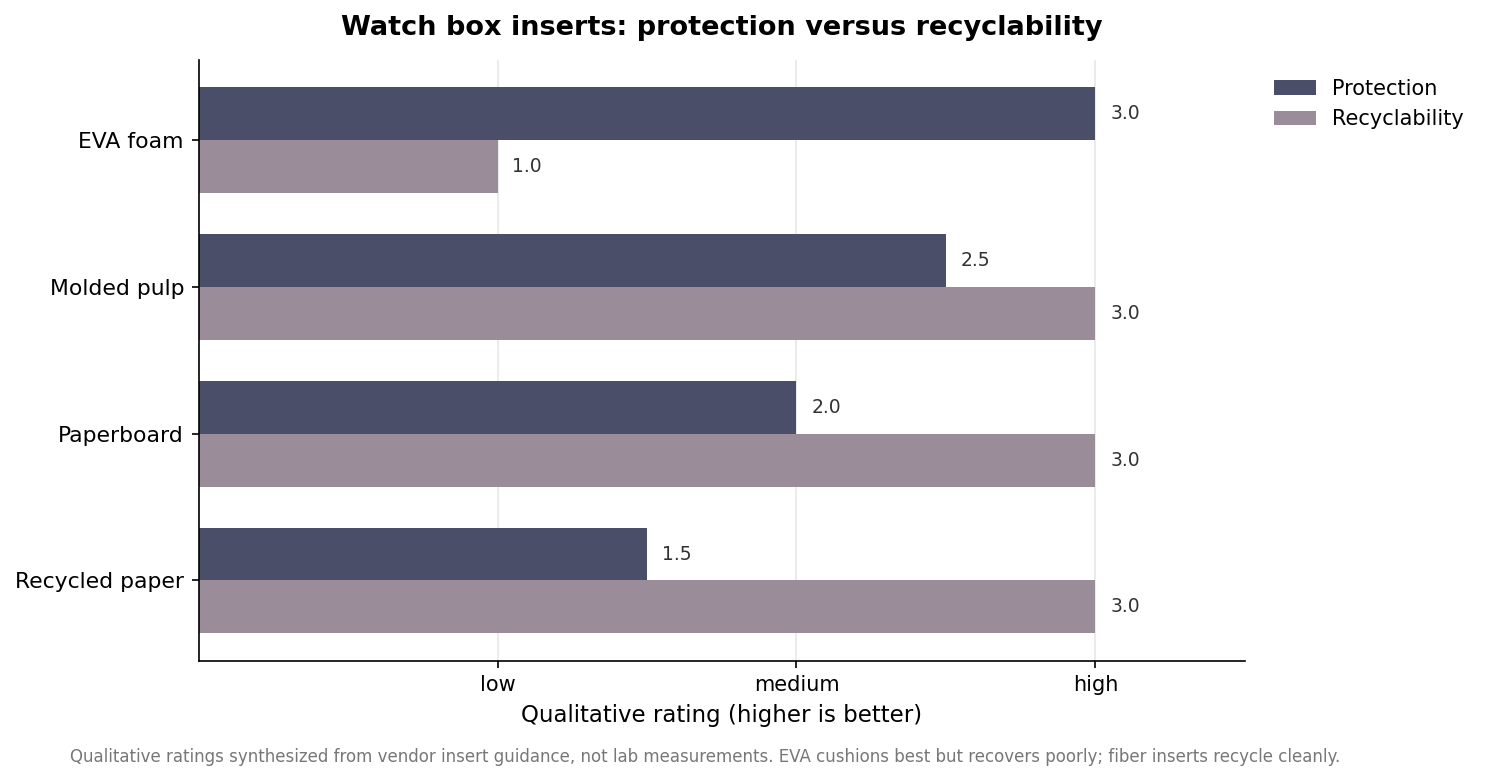
The interior is the hardest part of a watch box to make both protective and recyclable. A watch needs to be held in a fixed position so it does not rattle against the walls in transit, and the material that does that best is often the least recyclable. EVA foam, cut or molded into a precise cavity or shaped into a pillow, offers high cushioning and holds a watch firmly, but it is difficult to recover through paper recycling streams and is not plastic-free. Molded pulp, formed from paper fiber into shaped cavities, provides medium-to-high protection and recycles cleanly with the rest of the box, at the cost of tooling and a longer sampling cycle to get the fit right. Paperboard inserts and trays are cost-efficient and fully recyclable but offer only medium shock absorption, which is fine for a boxed retail handoff and less ideal for a box that ships alone. Recycled paper fill is the greenest and the least protective, suited to light or well-nested items rather than a bare watch.
For most watches the realistic choice comes down to a molded-pulp cavity with a fiber or recycled-fabric pillow when sustainability leads, or a shaped EVA insert when maximum in-transit protection leads and you are willing to accept a mixed-material interior. There is no single right answer, only the trade-off drawn honestly.
Weighing the trade-offs for a watch specifically
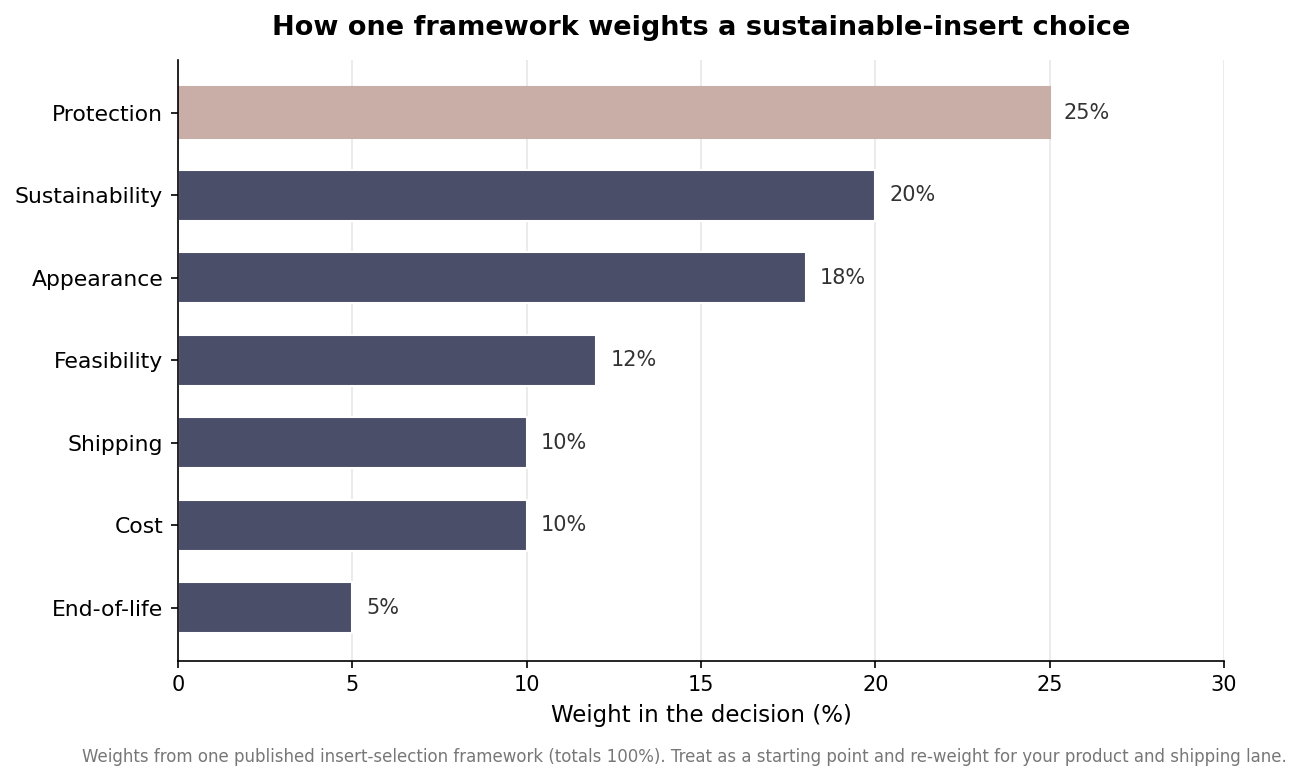
A watch box is not a shipping box, and that changes how you weight the decision. One published framework for choosing a sustainable insert weights protection most heavily at 25 percent, then sustainability at 20, appearance at 18, feasibility at 12, cost and shipping at 10 each, and end-of-life at 5. That ordering is a useful sanity check: protection still leads, because a green box that lets a watch get scratched has failed at its one job, but sustainability and appearance together outweigh it, which is exactly why premium watch packaging is where fiber inserts have gained the most ground. Re-weight it for your own situation. If your boxes travel alone through the mail, push protection and shipping up. If they are handed over in a store inside a shopping bag, appearance and end-of-life deserve more. The point is to make the weighting explicit before you fall in love with a sample.
What the certifications actually promise
Certifications turn a vague eco claim into something verifiable, but each one covers a narrow thing. FSC and PEFC certify that the paper fiber comes from responsibly managed forests, which speaks to sourcing, not to whether the finished box is recyclable or compostable. A home-compostability mark such as TÜV Austria OK Compost Home certifies that a material breaks down in home composting conditions, which is a claim about disposal, not sourcing. A soy-ink certification speaks only to the ink. None of them, on its own, makes a box “sustainable”; together they let you substantiate specific claims and avoid greenwashing. When you brief a supplier, ask which certifications apply to which component, get them in writing on the quote, and confirm that any recyclability claim accounts for the insert and coating, not just the bare board. A box that is honestly 90 percent recoverable and says so will age better with customers than one that oversells a green story the materials do not support.