If you sell watches — or anything that deserves to arrive looking like a gift instead of a shipment — the packaging is doing half the selling. Custom watch boxes are one of the highest-leverage upgrades a small watch brand can make: the unboxing photo gets shared, the box gets kept on a dresser, and the customer remembers your name instead of a generic Amazon insert. But before you fire off a “send me a quote” email, it helps to know what suppliers actually require: minimum order quantities, how long production really takes, and which materials are worth paying more for.
This guide pulls together current numbers from the packaging suppliers who publish them, so you can walk into a quote conversation knowing roughly what to expect instead of guessing. None of the figures below are estimates — each one is attributed to the company that states it.
Source: Fast Custom Boxes, IBEX Packaging, Teal Packaging, Boxlark, Plus Printers, and Alibaba.com supplier listings, accessed August 2026
How custom watch boxes are priced and ordered
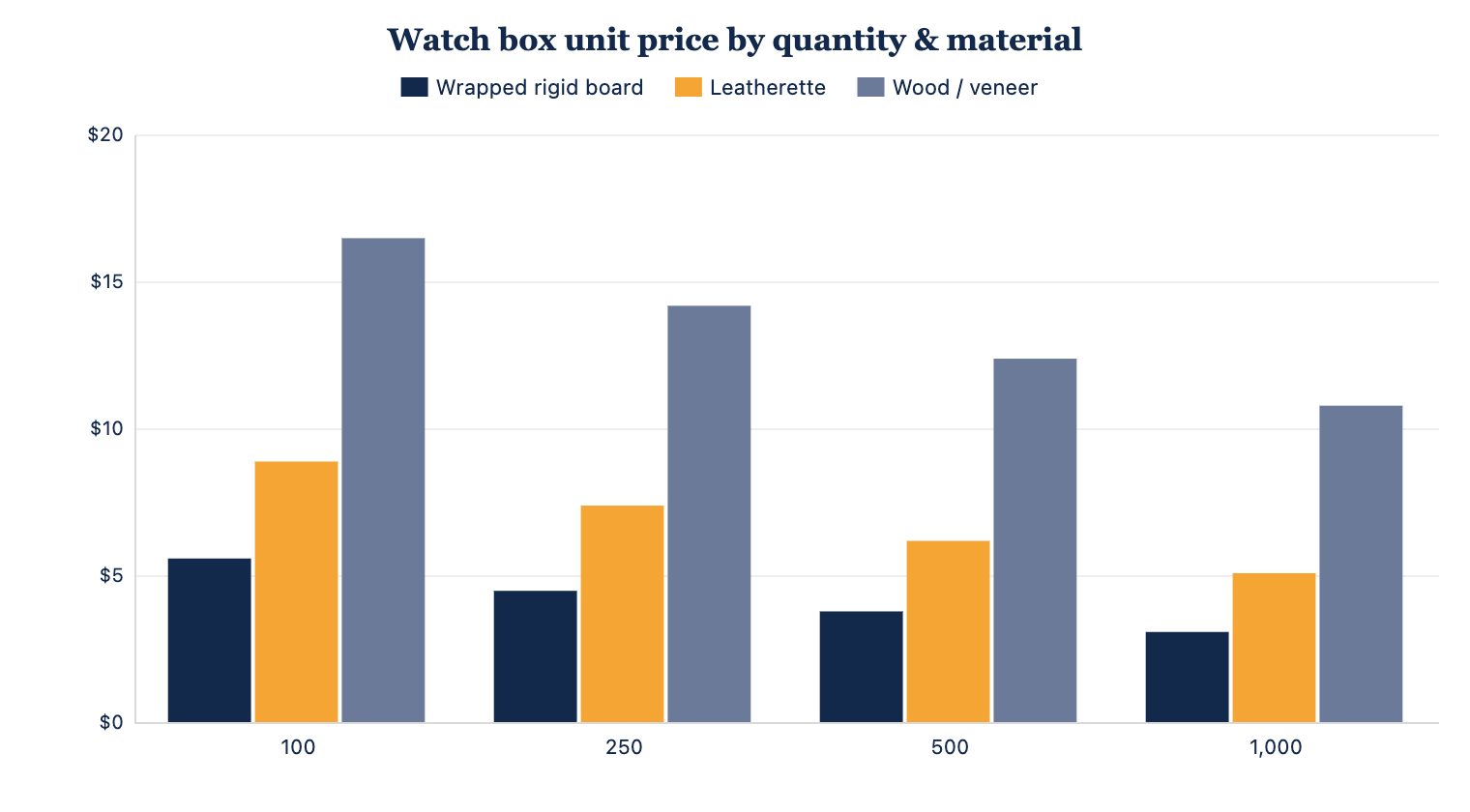
Custom watch boxes are almost always quoted per unit, and that per-unit price drops as your order size grows — which is why every supplier pushes you toward their minimum order quantity (MOQ) rather than a one-off run. The MOQ is set by the die-line and print setup cost: a supplier has to cut a mold or plate for your box shape and design before printing a single unit, so they need enough units to spread that fixed cost across.
In practice, most packaging suppliers cluster around a 50-100 unit MOQ per design, though a few will go lower if you ask, and at least one supplier we found advertises no minimum at all for standard styles. That last option usually comes with a higher per-unit price, so it only makes sense for a very small test batch.
- Fast Custom Boxes: MOQ of 50 units per design.
- Instant Custom Packaging: MOQ of 100 boxes per size/style, reducible to 50 on request.
- Blue Box Packaging: MOQ starts at 100 units.
- IBEX Packaging: minimum order of 100 watch boxes.
- Plus Printers: flexible minimums starting around 100 units.
Lead times: what to expect from order to delivery
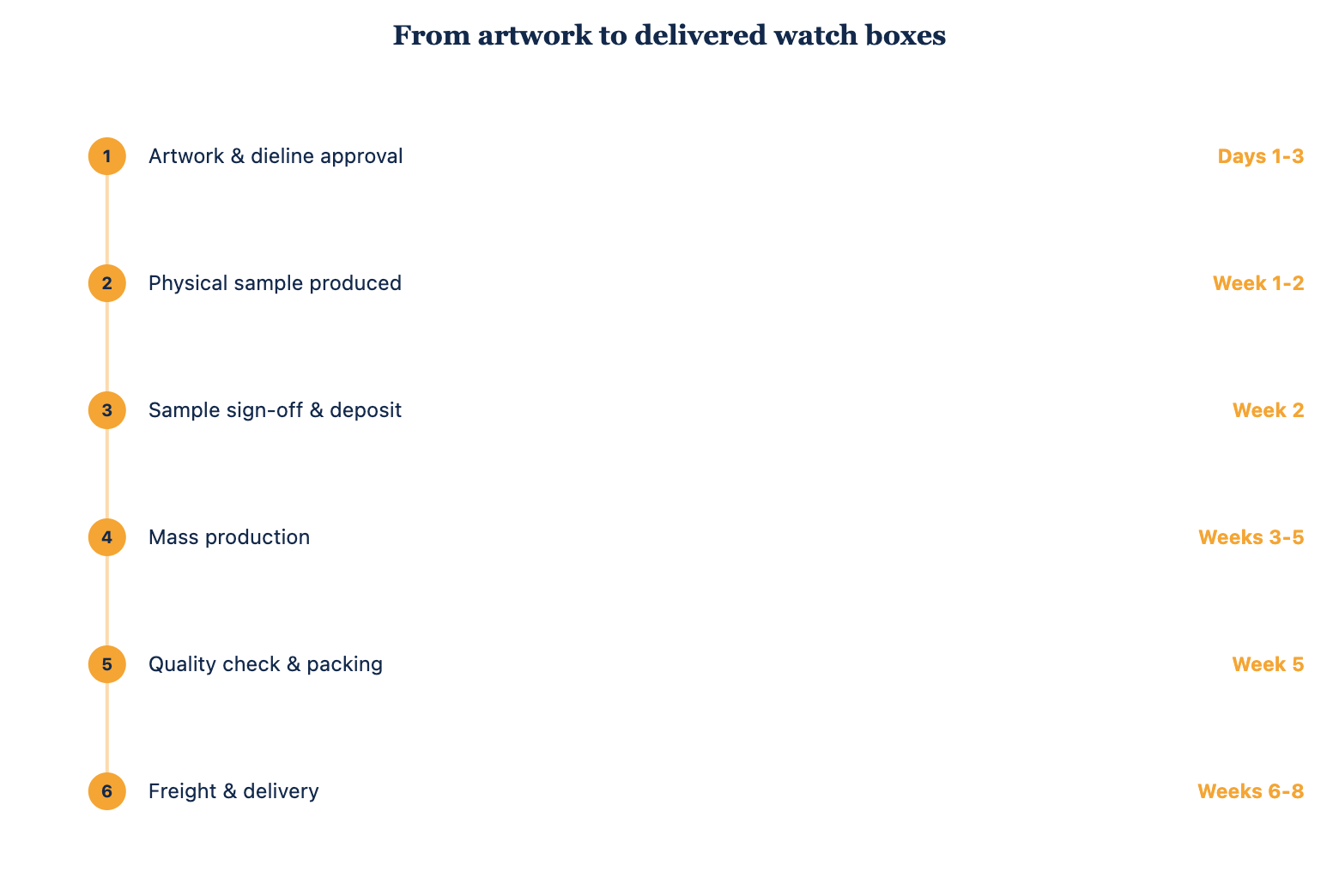
Once you approve a proof, production on custom watch boxes generally takes one to two weeks, with rush service available at most shops for an added fee. Build the lead time into your launch date with margin — a proof revision or a color mismatch on the first prototype can easily add three to five days before production even starts.
If you’re stocking up for a holiday launch, work backward from your ship date and add at least a week of buffer beyond the quoted production time for shipping and customs if the boxes are coming from overseas.
| Supplier | Standard Lead Time | Rush Option |
|---|---|---|
| Teal Packaging | 7 business days | 5-7 days (upcharge) |
| IBEX Packaging | 7-12 business days | not offered |
| Boxlark | 8-10 days | 4-6 days |
| Plus Printers | 12-15 days | not specified |
Choosing the right material for custom watch boxes
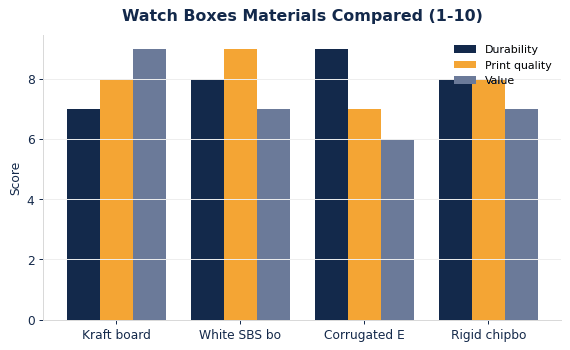
Material is the biggest lever on both cost and perceived value. Packaging suppliers generally group watch box materials into three tiers, and knowing which tier you’re shopping in keeps quotes from surprising you.
Solid wood — mahogany, walnut, and similar hardwoods — sits at the premium end. It takes laser engraving cleanly, feels substantial, and photographs well, but it costs more per unit and is heavier to ship, which matters if you’re paying freight by weight. Genuine leather sits in the same premium bracket: it reads as luxury but gets expensive fast at higher volumes.
The mid-tier is where most small watch brands land: rigid MDF (medium-density fiberboard) wrapped in a leatherette, linen, or printed paper exterior. MDF is more dimensionally stable than solid wood and takes foil stamping and embossing just as well, at a fraction of the material cost. Faux leather and laminated rigid board fall into this same bracket.
Budget options — plain cardboard, kraft paperboard, or thin plastic — are the least expensive and easiest to mass-produce, but they don’t hold embossing well and tend to feel disposable, which works against you if the box itself is part of the customer’s unboxing experience.
- Premium: solid wood (mahogany, walnut), genuine leather.
- Mid-tier: MDF with leatherette or fabric wrap, faux leather, laminated rigid board.
- Budget: cardboard, kraft paperboard, plastic.
Single-slot, multi-slot, and other design decisions
Beyond material, the configuration of the box changes both price and MOQ. A single-watch box with a foam or velvet pillow insert is the simplest and cheapest option to produce — it’s a small footprint with minimal interior tooling. Multi-slot cases, especially ones with a hinged glass lid, a felt-lined drawer, or a removable watch cushion for each slot, cost more per unit because the interior requires more separate components and assembly steps.
Closures and finishing touches also affect the quote. A simple flip-top or slide lid is the cheapest closure; a magnetic clasp, ribbon pull, or branded seal sticker adds a small per-unit cost but noticeably raises the perceived quality. Foil stamping (gold or silver logo imprint) and blind embossing are the two most common ways to put a brand mark on a box, and both work better on rigid materials — wood, MDF, or leatherette — than on thin cardboard.
If you’re deciding between configurations for a first order, a single-slot pillow box in leatherette-wrapped MDF with a foil-stamped logo is the combination most small brands land on: it hits the sub-100-unit MOQ most suppliers offer, keeps per-unit cost down, and still photographs like a premium product.
Working with a supplier: proofs, prototypes, and common mistakes
Every reputable packaging supplier will send a digital proof before production and most will offer (or let you pay for) a physical prototype. Don’t skip the physical sample if this is your first run with a given supplier — screen colors, especially deep blues and blacks, routinely shift once printed on a leatherette or fabric wrap, and foil stamping that looks crisp in a mockup can look thin or uneven on the actual material.
Measure your product against the interior dimensions before approving the die-line, not just the exterior box size. A watch box built around a generic pillow insert may not fit a chunkier case or a metal bracelet without the lid bowing. If you sell more than one watch size, ask whether the supplier can adjust the pillow insert without re-cutting the outer box mold — that keeps your reorder cost down if you add a new watch line later.
Finally, confirm what “included” actually covers in the quote. Some suppliers bundle the die-line and plate setup into the unit price for orders above their MOQ; others charge it separately as a one-time fee regardless of quantity. That setup fee is usually waived or discounted on reorders of the same design, which is worth asking about upfront if you expect to reorder.
Frequently asked questions
What’s the minimum order for custom watch boxes?
Most suppliers set their MOQ between 50 and 100 units per design. A few will negotiate down to 50 on request, and at least one supplier offers no-minimum orders on standard styles at a higher per-unit price — useful for testing a design before committing to a full run.
How long does it take to get custom watch boxes made?
Standard production typically runs 7-15 business days after you approve the proof, depending on the supplier and how complex your design is. Rush production is available from several suppliers and can bring that down to 4-7 days for an added fee. Add extra time for international shipping if your supplier is overseas.
What material should I choose for a small watch brand’s packaging?
Rigid MDF wrapped in leatherette or fabric is the most common choice for small and mid-size brands. It takes foil stamping and embossing well, holds its shape better than plain cardboard, and costs significantly less than solid wood or genuine leather at the same order volume.
Should I order a prototype before the full production run?
Yes. Colors, foil finishes, and interior fit routinely look different in hand than they do in a digital mockup. A physical prototype catches those issues before you’ve committed to 50-100+ units of the wrong shade or a pillow insert that doesn’t fit your watch case.
Do custom watch boxes come with interior inserts included?
It depends on the supplier and package tier — some include a standard foam or velvet pillow insert in the base price, while others quote the insert separately, especially for multi-slot or drawer-style boxes. Ask specifically whether the insert is included and whether it can be resized without re-cutting the outer box mold.
The bottom line
Custom watch boxes are one of the few packaging upgrades where the return is easy to see: customers photograph them, keep them, and associate the box with your brand every time they reach for the watch. The numbers above — MOQs mostly in the 50-100 unit range, lead times of one to two weeks, and MDF-with-leatherette as the material most small brands settle on — should give you a realistic baseline before you request quotes.
Get a physical prototype in hand before you commit to a full order, confirm what’s included in the quoted price, and build shipping time into your launch date rather than your ship date. That’s usually the difference between a smooth first order and a scramble two weeks before launch.